
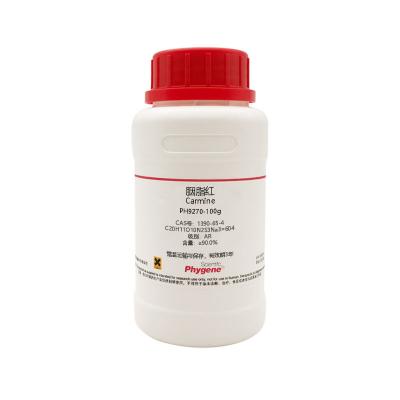

PH9270 | 胭脂红,AR,≥90.0% Carmine CAS号:1390-65-4
- PH9270
- 飞净 PHYGENE
- 福建省福州市
- 现货
- 按需
- 议价
- 2023-12-29 17:13:07
福州飞净生物科技有限公司
一键申请试用
咨询
加入意向单
联系方式
| 产品名称 : | PH9270 | 胭脂红,AR,≥90.0% Carmine CAS号:1390-65-4 |
| 产品品牌 : | 飞净 PHYGENE |
英文名称:Carmine;Alum lake of carminic acid;Cochineal;Nacarat;Natural Red 4 ;7-beta-D-Glucopyranosyl-3,5,6,8-tetrahydroxy-1-methyl-9,10-dioxo-anthracene-2-carboxylic acid
其他名称:虫红;洋红;卡红;胭脂虫红;7-β-D-吡喃葡萄糖基-3,5,6,8-四羟基-1-甲基-9,10-二氧代-蒽-2-羧酸;胭脂虫粉;洋红色淀;洋红酸色淀
CAS号:1390-65-4
C20H11O10N2S3Na3=604
级别:AR For microscopy
含量:≥90.0%
鉴定:合格
性状:鲜红色粉末或片状物,易磨成粉。系胭脂红酸的铝钙色淀,溶于硼砂液,还溶于碱金属的氢氧化物或碳酸盐类成深红色溶液,部分溶于热水,几乎不溶于冷水或稀酸
用途:生化研究。制备胭脂红酸;胚胎学中作整体染色;细胞核染色;滴定氨溶液指示剂;显微分析;荧光分析;染料、食物的着色等
保存:常温运输与保存,有效期3年
Carmine also called cochineal (for the insect from which it is extracted), cochineal extract, crimson lake or carmine lake, natural red 4, C.I. 75470, or E120, is a pigment of a bright-red color obtained from the aluminium complex derived from carminic acid. It is also a general term for a particularly deep-red color.
As confirmed by reflectance spectroscopy, carmine reflects mostly red light, i.e., wavelengths longer than about 603 nm.
Carmine can be used in histology, as Best's carmine to stain glycogen, mucicarmine to stain acidic mucopolysaccharides, and carmalum to stain cell nuclei. In these applications, it is applied together with a mordant, usually an Al(III) salt.
Carmine was used in dyeing textiles and in painting since antiquity. It is not very stable in oil paint, and its use ceased after new and better red pigments became available.
其他名称:虫红;洋红;卡红;胭脂虫红;7-β-D-吡喃葡萄糖基-3,5,6,8-四羟基-1-甲基-9,10-二氧代-蒽-2-羧酸;胭脂虫粉;洋红色淀;洋红酸色淀
CAS号:1390-65-4
C20H11O10N2S3Na3=604
级别:AR For microscopy
含量:≥90.0%
鉴定:合格
性状:鲜红色粉末或片状物,易磨成粉。系胭脂红酸的铝钙色淀,溶于硼砂液,还溶于碱金属的氢氧化物或碳酸盐类成深红色溶液,部分溶于热水,几乎不溶于冷水或稀酸
用途:生化研究。制备胭脂红酸;胚胎学中作整体染色;细胞核染色;滴定氨溶液指示剂;显微分析;荧光分析;染料、食物的着色等
保存:常温运输与保存,有效期3年
Carmine also called cochineal (for the insect from which it is extracted), cochineal extract, crimson lake or carmine lake, natural red 4, C.I. 75470, or E120, is a pigment of a bright-red color obtained from the aluminium complex derived from carminic acid. It is also a general term for a particularly deep-red color.
As confirmed by reflectance spectroscopy, carmine reflects mostly red light, i.e., wavelengths longer than about 603 nm.
Carmine can be used in histology, as Best's carmine to stain glycogen, mucicarmine to stain acidic mucopolysaccharides, and carmalum to stain cell nuclei. In these applications, it is applied together with a mordant, usually an Al(III) salt.
Carmine was used in dyeing textiles and in painting since antiquity. It is not very stable in oil paint, and its use ceased after new and better red pigments became available.